

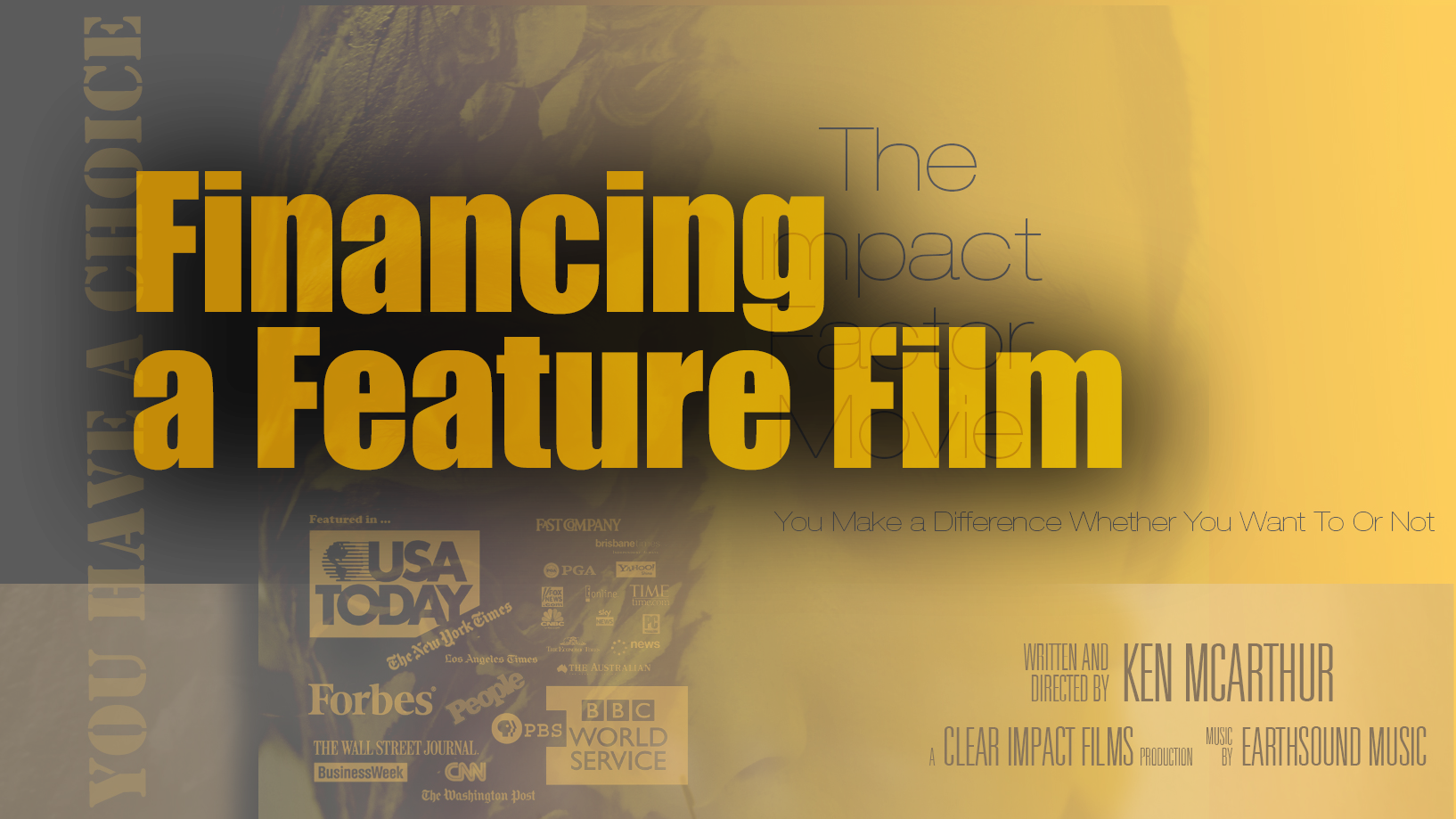
Logline: A diverse group of Philadelphia residents try to live significant lives as they collide in interweaving stories of impact.
FIRST STEP: Create the Story and Lock in the Script
I’ve completed the first draft of my feature narrative screenplay, called “The Impact Factor.”
It’s a drama about a diverse group of Philadelphia residents who try to live significant lives, as they collide in interweaving stories of impact.
The feature film is a mosaic of interrelated characters in search of power, peace, forgiveness, and meaning in a very noisy world. This movie follows the style of movies like Crash, Magnolia and Grand Canyon by showing the connections between diverse people in a tight geographic area and the impact our small actions have on the people around us.
NEXT STEP: Create the “Package”
No matter how you finance a film — unless you can afford to shell out the cash you need – you will need something to show potential investors and other financial stakeholders.
Typically, this takes the form of a prospectus and supporting materials which includes things like the script, the team, the budget, the distribution models, financial projections and more.
This is not as easy as you might imagine.
Some of the steps include:
- Doing a complete script breakdown to prepare a detailed budget.
- Filling key roles, actors, crew.
- Completing Marketing Plans and Financial Models
- Completing trailers, “look books” and prospectus materials so investors and understand and visualize your completed film.
NEXT STEP: Identify Potential Funding Sources
The potential funding sources for films are increasing every day. Here are a few of the possibilities for the Impact Factor feature film.
Equity
Equity is selling off a portion on your project for a cash investment made to your project by a single investor, a group of investors and personal investments. (friends and family)
In most cases, equity investments require that the investor own a stake in the film and in many situations that investment must be paid back (typically on their principal investment + 20%) before profit is seen on the side of the filmmakers.
Equity Crowdfunding
Title III of the Jobs Act has created a new opportunity for financing films called equity crowdfunding.
For filmmakers, the key element of the JOBS Act is Title III. Prior to its passage, it was illegal for “unaccredited investors” to invest in private companies. You could only get accreditation if you earned more than $200,000 a year, with a net worth of more than $1 million. With Title III, private investment is open to anyone. (Investors whose net worth or income is below $100,000 can invest up to $2,000 or 5% of their annual income or net worth, whichever is lower.)
Pre-Sales
Pre-sales are agreements made with distributors before the film is produced. A distributor decides how much your project is worth based on the “package” (the script, the attached talent, and crew, as well as the marketing plan) If you land a pre-sales contract, you can then take out a bank loan using the contract as collateral. In some cases, distributors will offer direct payment. (at a discounted rate)
Gap
Once there are solid assets in place, the company is now worth something, so you may be able to get a loan from a bank or a private lender based on collateral. Gap financing is only available when there is adequate security for the investor to leverage.
Tax Incentives
Individual state and country legislation enables producers to subsidize spent costs for production. Tax incentives require a producer to hire a certain number of local crew employees, rent from local vendors, and run payroll through local services.
Pennsylvania offers a 25% Tax Credit to films that spend at least 60% of their total production budget in the Commonwealth.
Deferred Expenses
Producers are able to avoid costs on a project if they are able to negotiate a deferred deal.
Agreements for deferred payment basically allow crew, cast, vendors, locations, and services to render services at no cost or a reduced cost until the film goes into profit.
Crowdfunding
Crowdfunding is a method of raising capital through the collective effort of friends, family, customers, and individual investors. This approach taps into the collective efforts of a large pool of individuals—primarily online via social media and crowdfunding platforms—and leverages their networks for greater reach and exposure.
Grants
There are thousands of grants available for filmmaking each year. The benefits of a film grant include:
- You do not have the burden of paying the money back.
- Grants often come in larger amounts of money, so it eliminates fundraising in small increments
- Grants provide publicity when the grant is announced
- Grants provides credibility for your project.
NEXT STEP: Create a Detailed Plan and Sequence for Locking in the Funding Sources
With your package in place, talent signed on, a strong team on board, and a well-developed script, you can now start choosing the funding sources you want to leverage and start putting together a launch plan for creating as much excitement, synergy and community building, not to mention the greatest amount of FINANCIAL resources from your campaign.
Planning now will maximize your dollars.
NEXT STEP: Execute the Plan
Get some rest first, because It’s going to be intensive. But, congratulations! You’ve done the pre-work.
Now all you need to do is execute the plan!
So what’s the plan for financing the Impact Factor Movie?
March right through all of those steps:
- Lock in the Script
- Create the Package
- Identify the Funding Sources
- Create a Detailed Plan and Sequence for Locking in the Funding Sources
- Execute the plan
This is preliminary, because although we’ve done a LOT of work getting to where we are, we still aren’t finished with all of these steps.
Right now we are working through script breakdown, casting, crew and team, budgeting, but already it’s starting to come together.
At this point, it looks like the Impact Factor Movie can be made for a $250K budget on an 18 day shoot.
That budget could scale up based on the total amount of money we are able to raise through all of our funding resources.
Equity Partners First
Most likely I’ll try bringing in a couple of equity partners first. That gives us a solid base to build on.
Why would someone want to invest in a film?
For U.S. investors and films that qualify, a $1,000,000 investment in a film would offer approximately $396,000 reduction in federal tax liability and another $250,000 to $350,000 or more in cash refunds via state incentives prior to Picture revenues. This limits the capital at-risk to approximately 30% of the total investment. If the producer secures international and broadcast presales for its slate of films, the risk exposure could be virtually eliminated while the upside in future revenues still to come is limitless.
Inclusive Equity Options
Then I’ll likely reach out to smaller investors via the crowd equity funding made possible through Title III of the Jobs Act.
Traditional Crowd Funding
We will definitely launch an extensive traditional incentives based crowdfunding campaign. This type of funding raises not only additional funds, but greatly increases the visibility and audience for the project.
Grants
Of course we will pursue all grant sources.
Tax Incentives
Tax incentives offer a percentage of the in-state spend back in rebate form. This allows us to offset our investors risk.
Pre-Sales
Pre-sales offer projections of value based on the elements we’ve brought together. Again to offset our investors risk.
Working together we can do so much than we ever can alone!
Let me know how you would like to be involved in this amazing project!
All the best,

Ken McArthur
Best-Selling Author and Producer
KenMcArthur.com
The Impact Factor Movie
The Impact Masterminds
The Impact Action Plan Workshops
P.S. Like I always say, working together, we can do so much more than we can alone. Here are a few ways I might be able to help.
P.P.S. Here’s the addresses to find me on Twitter and Facebook …
Twitter:
http://twitter.com/KenMcArthur
Facebook:
http://www.facebook.com/pages/Ken-McArthur/20103565427
Fascinating, Ken. Thanks for sharing what you have been going through during the past year or so. It sounds Intense.
Hey Richard, It’s an exciting time to be alive! Just wish there was more time in a day!