
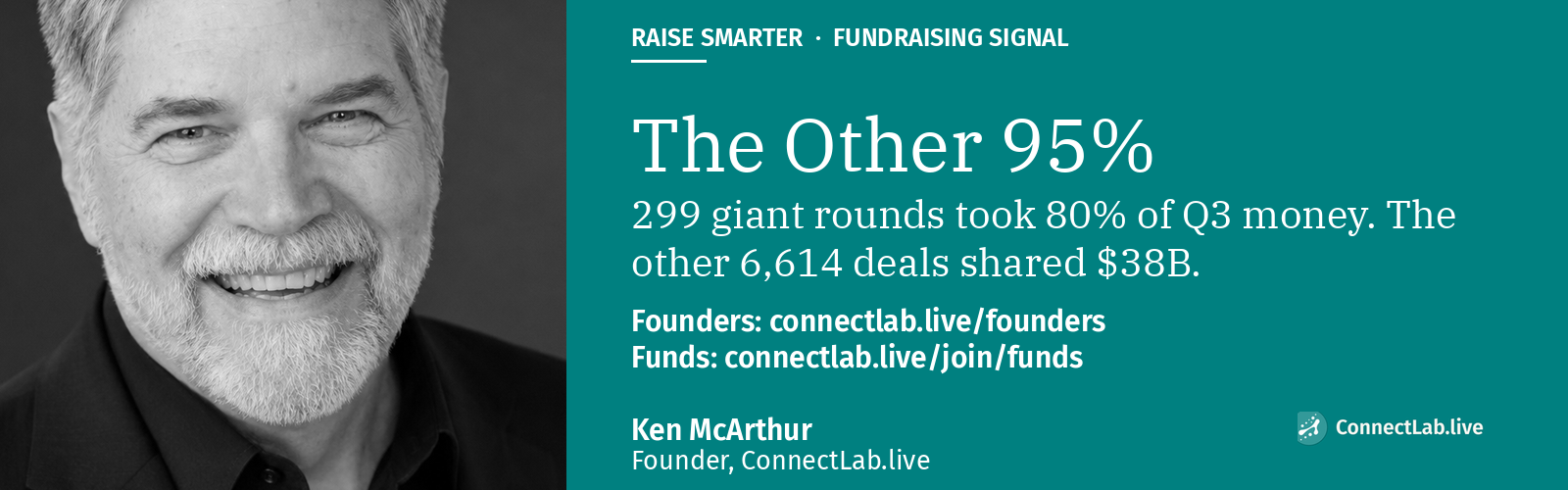
In Q3 2026, startups worldwide raised $187.2 billion over 6,913 deals. Just 299 of those deals were rounds of $100 million or more — 4.3% of all deals — and they took $149.2 billion, 80% of the money. The other 6,614 deals shared $38 billion. The average deal with the giants in it is $27.1 million. Without them, it is $5.7 million. (CB Insights, State of Venture Q3’26, as reported by The Founders’ Stack; the averages are The Founders’ Stack’s own calculation from CB Insights data.)
The doors are fewer and the cheques are bigger. The world averaged about 5,197 seed and Series A rounds per quarter in 2026, against about 10,160 per quarter in 2022 — an Early-Stage Index of 51, down 18% on 2025. But the median early-stage round grew to $2.32 million, up from $1.74 million in 2022. And the early money is flowing to hardware: hardware startups on Carta raised nearly $34 billion through Q3, up 125% year over year, with the largest median seed round of any sector at $6.1 million and the largest median seed pre-money valuation at $27.2 million. (Carta, State of Private Markets: Q3 2026, published Nov 5, 2026.)
Two seed rounds from the weekend show how founders get in. Bharat Semi, a chip startup in New Delhi, raised a $24 million seed, announced November 15, led by Info Edge Group, South Park Commons, and Indus Bridge Ventures — while still pre-revenue, on named design wins with General Atomics and Kaynes Semicon. Daisytuner, a compiler startup in Darmstadt, Germany, founded in 2024, raised a 6 million euro seed announced today, November 16, co-led by Elaia and LEA Ventures — on a published benchmark showing Qwen 2.5 running up to 18% faster than vLLM on AMD Instinct GPUs. In both cases, the proof came first and the money followed.
There is good news underneath, too. Down rounds are at a four-year low — just 13% of rounds in Q3 — and a founder raising every round from seed through Series D at 2026 median dilution rates would give up about 53% in total, against about 66% at 2019 rates (Carta’s hypothetical compounding exercise at median rates).
The lesson is one I wrote about in The Impact Factor, in a chapter called “Chaos”: “If you aren’t feeling strong enough to change the world, think about gravity. The weakest of all the forces in the universe moves galaxies. Or if you feel you are too small to make a difference, imagine how small the range of influence the strong force has. It can’t change anything beyond a single nucleus, but it is the glue that holds everything together.” Most founders live in the other 95%. The giants take the headlines. The small forces hold everything together.
Founders: start with a 21-day free trial of Founder Pro at https://connectlab.live/founders. Funds: https://connectlab.live/join/funds. Subscribe to Raise Smarter: https://www.linkedin.com/newsletters/raise-smarter-7514657628552183808/
Sources: CB Insights via The Founders’ Stack, “The Other 95%, Q3 2026” (~Nov 1, 2026); Carta, State of Private Markets: Q3 2026 (Nov 5, 2026); TechCrunch, Bharat Semi (Nov 15, 2026); Unite.AI and EU Startups News, Daisytuner (Nov 16, 2026). Not legal or investment advice.