
If you’re raising and a corporate investor is on your list, the latest data has a clear message: corporates are still investing, but they’re picking their spots with care. Here’s what the two newest reports say, what they don’t, and how to build a path to a strategic check.
Two Reports, Two Ways of Counting
Two Q3 2026 reports on corporate venture capital (CVC) came out last week. They use different methods and coverage, so their numbers should never be added together or swapped. Each figure below is attributed to its source.
Aranca (Quarterly Spotlight: Corporate Venture Capital Deal Analysis Q3 2026, October 8) counts 988 CVC transactions in Q3, down 21.1% from Q3 2025, “extending a multi-year contraction in corporate venture participation.” But CVC capital reached $56.7B, 18.6% above Q3 2025. Aranca calls it “a shift toward more disciplined capital allocation rather than a retreat.”
Global Corporate Venturing (GCV) (October 9) reports that “corporations took part in 1,489 funding rounds in the July to September period, an 8.1% increase over the same quarter last year,” the most corporate-backed rounds of any quarter “since at least 2023.” GCV puts disclosed value at $84bn, double Q3 2025. (Most of GCV’s article is paywalled; we’re citing only its opening summary.)
So which is it, fewer deals or more? A fair reading: fewer corporate-led bets by one count, more corporate participation by another, and both see growth outside the US.
Fewer, Bigger, More Deliberate
Aranca’s breakdown shows where corporate money is going:
- Later rounds took 29.6% of CVC deployment ($16.8B) on only about 10% of deals.
- Round 5 funding rose 99.8% year over year, to $10.4B.
- Salesforce Ventures was the most active CVC with 19 investments, followed by Global Brain with 15.
Aranca also notes corporates are “increasingly using venture capital as a means of accessing emerging technologies and strategic capabilities in addition to pursuing financial returns.” In other words, they’re buying strategic fit, not just a return.
Why a Corporate Check Is Different
A financial investor mostly asks one question: will this company return the fund? A corporate investor asks that too, but it also asks a second one: what does this company do for our business?
That second question changes everything about how you approach them. The venture team may write the check, but the case for it usually rests on a business unit that would use your product, sell it, build on it or learn from it. If that business unit doesn’t know you, the venture team has a harder story to tell inside its own company.
That’s why a cold pitch to a corporate venture arm so often goes nowhere, and why a warm relationship with the right team inside the business so often does. Makes sense, right?
The Map Is Widening
Both reports point to growth outside the US.
- Aranca: North America took 56.7% of CVC capital ($32.1B). Year over year, CVC capital rose 57.5% in Asia and 51.9% in Europe. Asia led on deal count (463), and Europe drew $10.0B across 138 deals.
- GCV: growth came “largely from increased activity in markets outside of the US,” including China, Japan and South Korea, and Europe had its most corporate-backed deals since 2023.
One Example of the Pattern: Crusoe
On September 17, 2026, Crusoe announced the initial close of an anticipated $3.9B Series F at a $30.9B post-money valuation. Atreides Management, Mubadala Capital and Valor Equity Partners co-led, and NVIDIA and Salesforce Ventures were in the round. Aranca names it the quarter’s largest CVC-backed deal.
This is an extreme late-stage round, far from a typical seed or Series A, so don’t treat it as a benchmark. What’s useful is the relationship pattern:
- Mubadala: “We have partnered with Crusoe since 2022, invested in every round since.”
- Valor’s Antonio Gracias: “We joined Crusoe’s journey almost six years ago.”
- NVIDIA is both an investor and a supplier. Crusoe calls itself “an NVIDIA Exemplar Cloud.”
The strategic investor is also a commercial partner, and the anchors are relationships that go back years. You can apply the same principle at seed.
What Founders Can Do Now
- Name the job. Do you want distribution, a design partner, technical credibility or capital? Each leads to a different team inside the corporate.
- Find the business unit, not just the venture arm. The investment case usually rests on a business unit that needs what you’ve built.
- Start commercial, then talk investment. With strategics concentrating dollars in later rounds (Aranca), a pilot or partnership is often the best first step at seed.
- Find the person who already knows the team. A former employee, a board member, a customer or a co-investor can make the introduction land.
- Read the terms with counsel. As general guidance, ask about rights of first refusal, information rights and how a corporate on your cap table might affect its competitors as future customers or buyers.
- Model, test, adjust. Run one pilot, learn what the business unit values, and refine your pitch before you ask for a check.
What GPs Can Do Now
- Treat corporates as partners and deal sources. The most active tech CVCs can bring portfolio companies pilots, partners and follow-on capital.
- Build ties before you need them. Know which corporate venture teams fit each portfolio company’s market, and who can introduce you.
- Look abroad. For international founders, corporate partners in Asia and Europe may be the more open door, given the growth both reports describe.
The Relationship Behind the Check
Corporate venture teams generally don’t run open applications. They invest where their business already has a relationship or a need. That makes the path in a relationship problem, and relationships can be mapped.
Much of that map is public. Form D filings list a company’s related persons, Form ADV shows advisers and their funds, and SEC filings and business registries show board seats and affiliations. ConnectLab.live maps those paths alongside your own contacts, so you can see who already sits between you and the right corporate team.
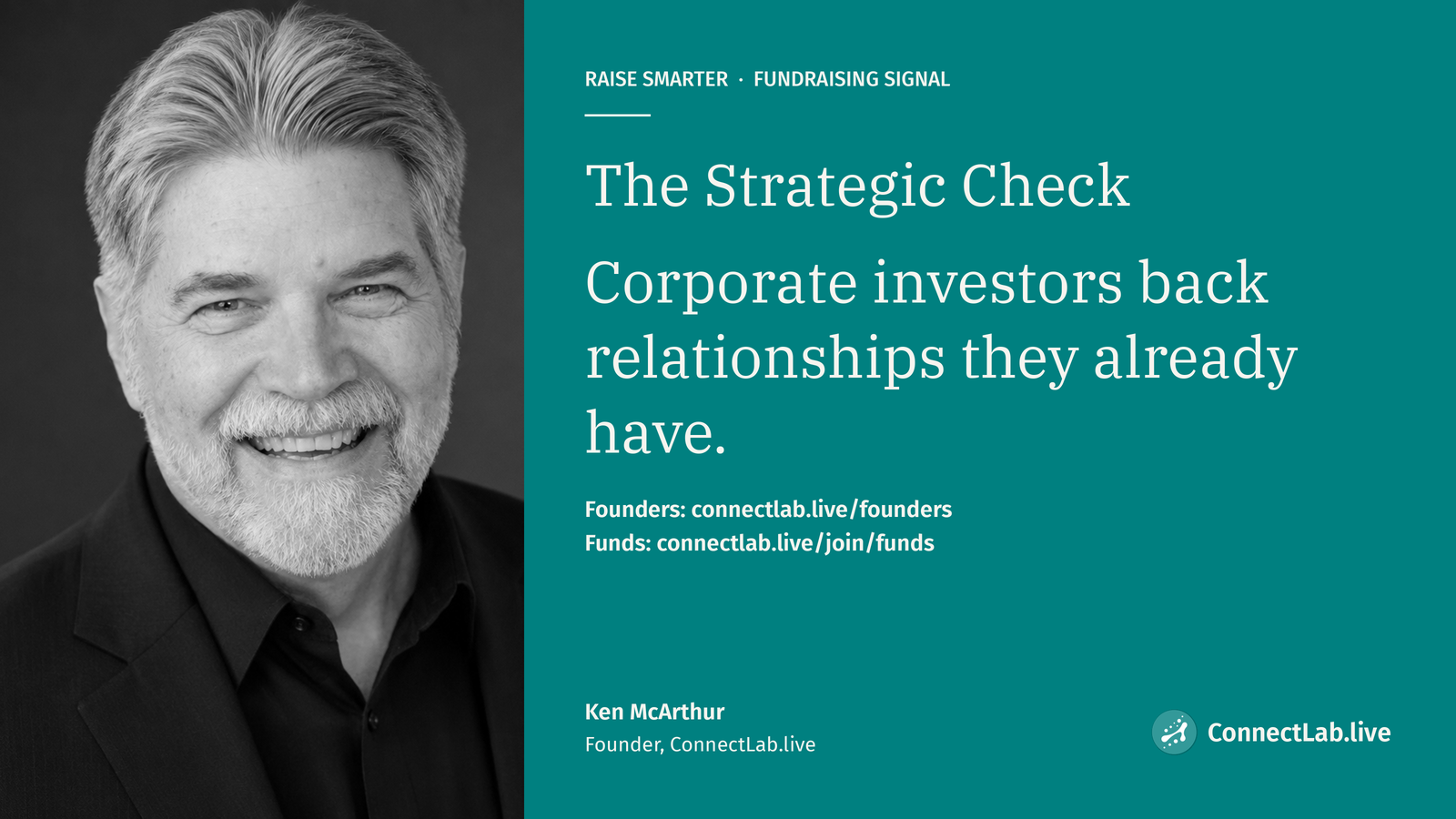
Connection is the currency of the 21st Century. A strategic check starts with a strategic relationship.
What’s one commercial relationship you could start this quarter that might turn into a strategic check next year?
If you’d like help with that, here’s an open invitation:
- Founders: map your warm paths to the right corporate team at https://connectlab.live/founders
- Fund managers: claim your fund on ConnectLab at https://connectlab.live/join/funds
- Subscribe to Raise Smarter for daily fundraising signals: https://www.linkedin.com/newsletters/raise-smarter-7514657628552183808/
All the best,

Ken McArthur
Best-Selling Author and Producer